Hicked
Overview
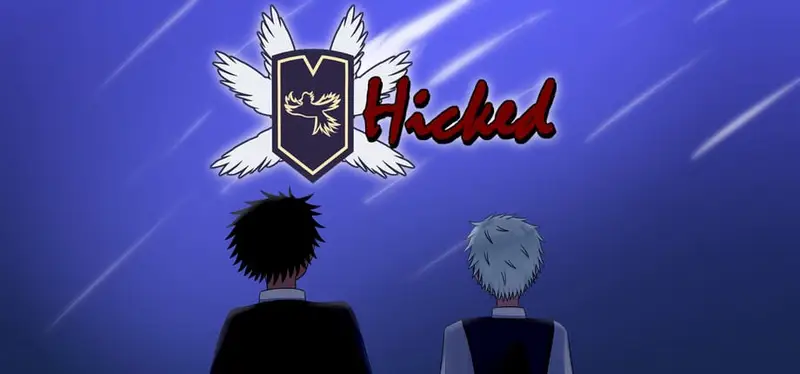
Hicked drops you into Kannagawa, the new capital prefecture of a dystopian Japan rebuilt centuries after a world war, where you play Ikaru Kai, a rural transplant who meets the white-haired people called God Killers.
It's an animated dating sim and visual novel with a male protagonist, and its hook is a monochrome, moonless world where the romance starts from a small act of kindness rather than a grand mission.
Ikaru, Makiri and the God Killers
Ikaru comes from a country town and arrives in Kannagawa knowing little about how the city treats its newest people. God Killers are recognizable by their white hair, and the discrimination they face is the first thing he learns about his new home.
He doesn't set out to change the world. His goal is smaller: help where he can. That leads him to Makiri Shogo, a classmate who is a God Killer and gets bullied for it.
Reading a dating sim built on prejudice
You play it as a visual novel, moving through scenes and choices as Ikaru gets closer to the people around him. The romance sits on top of the social tension. A school hallway is never only a school hallway here, because who gets mocked and who looks away says something about the city.
The animation helps carry mood in a setting described as colorless, with dim stars and a missing moon. Expect a quiet, serious tone more than a comic one.
Kannagawa as a setting
Kannagawa is meant to symbolize the rebuilt civilization, a showpiece capital that still hasn't fixed how it treats a group of its own residents. That gap between the polished new world and the people left outside it is the backdrop for every scene.
The game is adult, and its romantic scenes are part of the relationships rather than a separate mode. No specific caution themes are listed for it, though the plot deals openly with bullying and discrimination, which is worth knowing before you start.
Conclusion
Hicked is a romance-focused visual novel about a country boy, a bullied God Killer classmate, and a future Japan that rebuilt itself without becoming kinder. Its pull is the contrast between a small personal gesture and a very large social problem.
If that quiet, somber setup appeals, the rest follows from it.
Read moreRead less
Screenshots
Download
 FASTDROP
 LEWDUPLOAD
 GALAXYFILES
 UPLOADBAY
Related Games