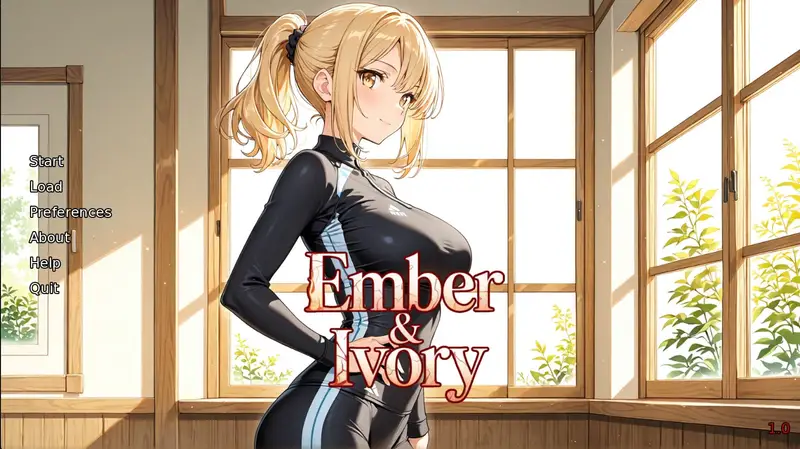
Ember&Ivory
Overview
Ember&Ivory sends you back to a mansion you didn't want to return to, where your father is gone and his much younger wife, Isabelly, is the only person who seems to be waiting for you. It's a kinetic novel with a male protagonist and a milf-led romance, which means you read and watch Lucas's homecoming unfold rather than steer it through menus.
The hook is the choice the source frames for him: mend what's broken with his family, or give in to an attraction that could wreck all of it.
Lucas and Isabelly in the mansion
Lucas is the point-of-view character, a son coming back to his father's opulent home after a long gap. Isabelly is the stepmother he finds there, described as young and hard to read. Their dynamic is the whole engine: luxury on the surface, family secrets underneath, and a pull between the two of them that neither can quite ignore.
The father stays offstage. His absence is what leaves the house so quiet and so charged.
Kinetic novel pacing and chapters
A kinetic novel has no branching menus, so there's no decision tree to optimize and no route to miss. You advance the text, take in the scenes, and let the writing carry the tension. Sessions feel closer to reading a serialized book than to playing a dating sim.
The material is split into numbered chapters, and the early ones spend their time on the house, the reunion and the slow build between Lucas and Isabelly. That structure makes it easy to stop and pick up where you left off.
Netorare and family themes
This is an adult game, and the romance is sexual. The caution themes are netorare and incest, the latter because Isabelly is Lucas's stepmother. Betrayal and divided loyalty are part of the premise rather than a side detail, so the tone leans toward guilt and temptation more than lighthearted flirting.
If either theme is a hard no for you, the setup won't change course.
Conclusion
Ember&Ivory is a linear, text-driven story about a son, his stepmother and a house full of things nobody says aloud. It trades player control for atmosphere and a single central question about desire against family. Read it for that tension, and know going in that betrayal themes are woven into the setup.
Read moreRead less
Screenshots
Download
 FASTDROP
 LEWDUPLOAD
 GALAXYFILES
 UPLOADBAY
Related Games